
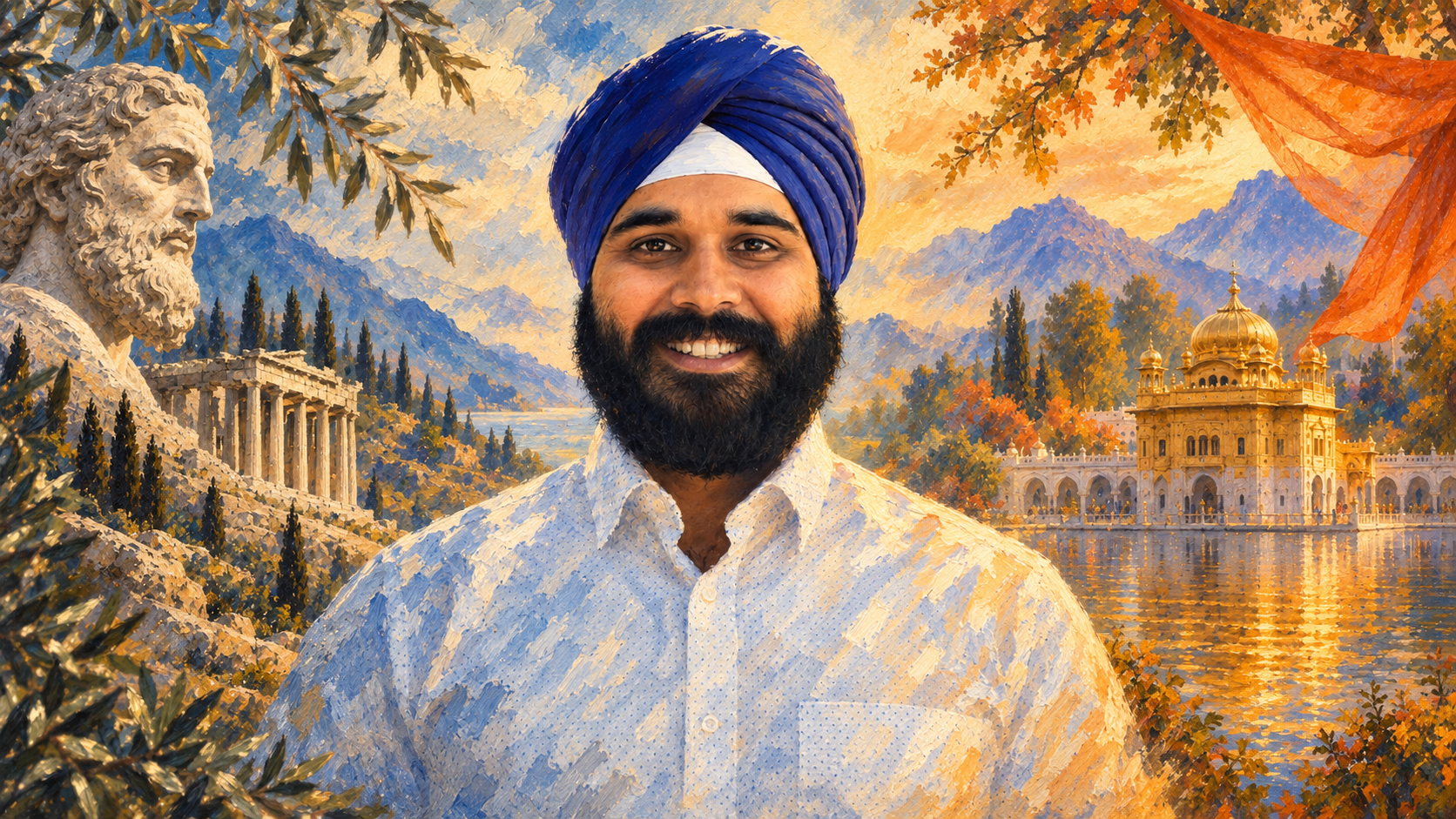
Over the past several decades, Anglophone philosophy has been trying to remember that it wasn’t born in Athens. Syllabi now include Confucius and the Buddha, journals run special issues on Africana and Indigenous thought, and “global philosophy” has become a recognized field rather than a rebuke. Yet one of the world’s largest religious traditions, with a scripture that is entirely philosophical poetry meant to be sung, has been almost completely absent from that expanded conversation. Sikhism gets left out not because it lacks a systematic ethics but because almost no one working in Anglophone philosophy has bothered to look.
This week the co-hosts are joined by Dr. Keshav Singh, Assistant Professor of Philosophy at the University of Alabama at Birmingham and author of the new (and open-access) Cambridge Element Sikh Ethics. Keshav works in ethics and epistemology, and his recent research uses the tools of analytic philosophy to reconstruct Sikh moral thought on its own terms rather than forcing it into categories the Western tradition already decided were the important ones. He walks us through the two levels of reality, the three terms he refuses to translate (hukam, haumai, sachiara), the five thieves, and why running off to a mountaintop to seek enlightenment would be, by Sikh lights, a moral failure.
Grab a drink and join us as we find out why truth is higher than everything, but truthful living is higher still.
In this episode, we discuss the following thinkers, ideas, texts, etc.:
- Keshav Singh
- Keshav Singh, Sikh Ethics (Cambridge Elements in Global Philosophy of Religion, 2026, open access)
- The ten Sikh Gurus
- Punjab
- Sri Guru Granth Sahib
- Monism (including priority monism)
- Plato, Republic (the allegory of the cave, Book VII)
- Ik Onkar (“one divine,” the opening of the Guru Granth Sahib)
- Baruch Spinoza
- Caste system in India
- Mughal Empire
- Hukam
- Haumai
- Sachiara (the truthful being)
- Aristotle, Nicomachean Ethics
- Asceticism
- The Five Thieves (“vices”): kam (lust), krodh (wrath), lobh (greed), moh (attachment), ahankar (arrogance)
- Maya (illusion)
- Seva (selfless service)
- Naam, Daan, Isnan (the three pillars)
- François de La Rochefoucauld on the selfish roots of virtue
- Akrasia / weakness of will
- Care ethics
- The Five Ks (markers of Sikh identity)
- Keshav Singh, “Vice and Virtue in Sikh Ethics” (The Monist, 2021)
- Keshav Singh, “Sikh ethics sees self-centredness as the source of human evil” (Psyche, 2025)
Like and Follow Hotel Bar Sessions!
Stay current with our most recent episodes, behind-the-scenes updates, announcements, and more! Follow us on your favorite platforms below:
Support Us on Patreon!
Enjoying our conversations? Keep them going by supporting Hotel Bar Sessions on Patreon. Your support helps us bring fresh content, deeper discussions, and exclusive perks for our community.