
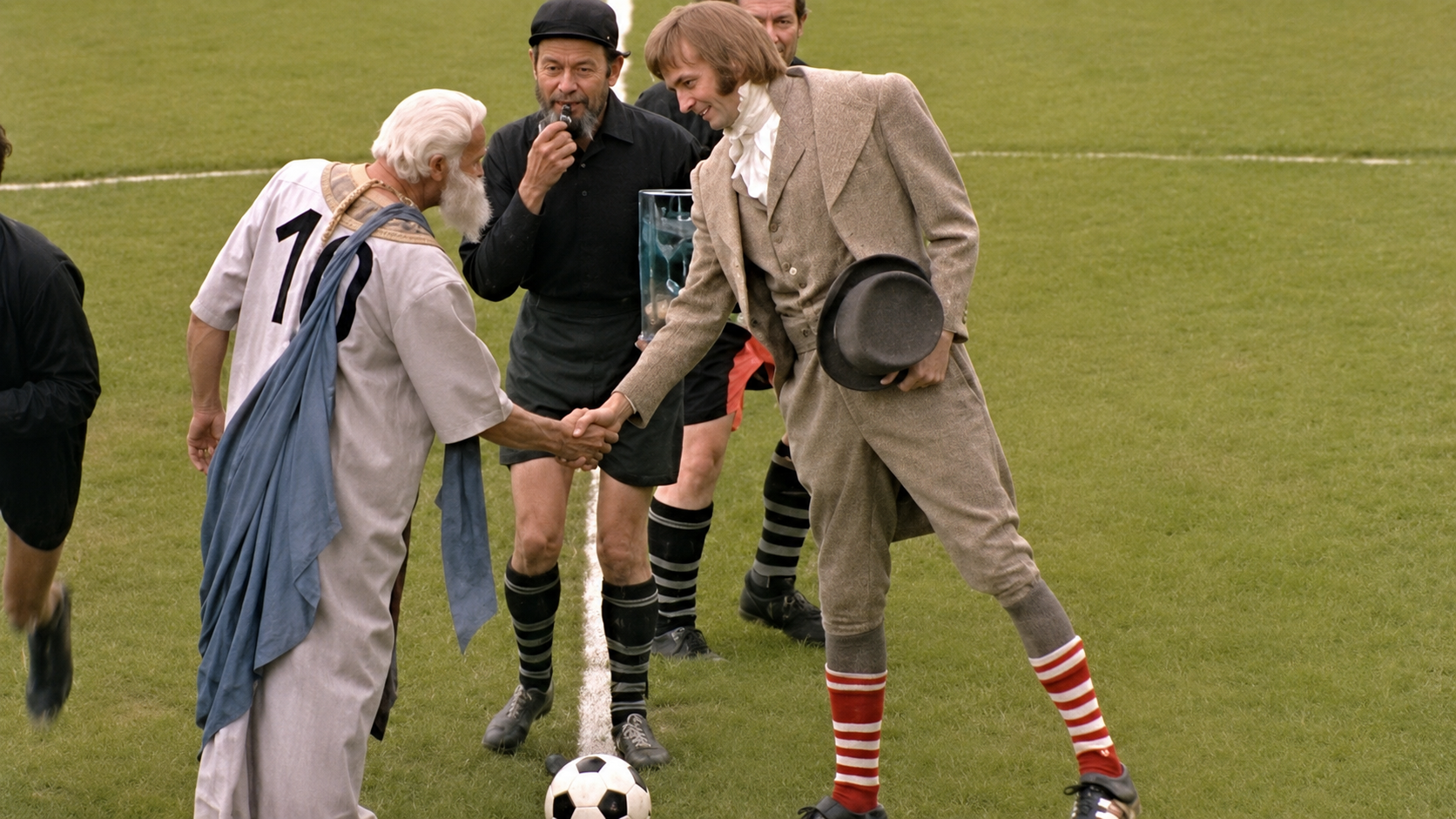
Sports are one of the few remaining arenas of public life where tens of millions of people voluntarily agree to care about the same thing at the same time. As the World Cup reminds us every four years, sports can build identities, drive economies, organize civic loyalties, and transform old geopolitical wounds into something that at least resembles a game. Whether you played Little League, follow your city’s team with religious devotion, or find the whole spectacle baffling, sports have philosophical stakes that run deeper than the scoreboard.
What actually makes something a sport — and does the answer matter? What does that tell us about fairness, rules, and what it means to win? Can fandom build genuine community, or is it just tribalism? And when institutions like the NCAA funnel the passions sports inspire into donor pipelines and broadcast deals, what gets lost and who gets exploited?
Grab a drink and join us as we step onto the field with Aristotle, Iris Marion Young, William James, and Bernard Suits to find out whether the philosophy of sport is worth playing.
In this episode, we reference the following thinkers, ideas, texts, etc:
- Plato — ancient philosopher and, per episode lore, a two-time wrestling medalist at the Athenian Olympics; his actual name is a nickname meaning “broad” (a reference to his shoulders)
- Socrates — famous for haunting the gymnasium to catch athletes on their way home and argue that a healthy body and healthy mind go together
- Plato, The Republic — specifically the section on gymnastics in the education of the auxiliaries and philosopher-kings
- David Hume — noted billiards player
- Martin Heidegger — allegedly cited Franz Beckenbauer, captain and later coach of the German World Cup–winning team, as one of the two most important philosophers of the 20th century
- Albert Camus — played goalkeeper; famously said everything he knew about philosophy he learned from football
- Hans-Georg Gadamer — reportedly watched a World Cup match and declared it the Hegelian dialectic in action
- Jacques Derrida — allegedly kicked a soccer ball at a conference in Perugia and broke an Etruscan vase; said he would have pursued a career in football had it not been for philosophy
- Bernard Suits, The Grasshopper: Games, Life and Utopia (University of Toronto Press, 1978)
- Philosophy of Sport (Stanford Encyclopedia of Philosophy)
- Aristotle
- Mind-body dualism /
- Iris Marion Young, “Throwing Like a Girl” (originally published in Human Studies, 1980; collected in On Female Body Experience, Oxford University Press, 2005)
- Maurice Merleau-Ponty — phenomenologist whose categories of embodiment, proprioception, and spatial orientation underpin Young’s analysis
- Erwin Straus — psychologist and phenomenologist whose biological explanation for gender differences in throwing Young explicitly argues against
- Paralympics / para-sports — raised as a test case for whether definitions of sport that center normative able-bodied physicality can account for disabled athletes
- Esports — debated throughout as a borderline case; the episode probes whether hand-eye coordination and speed-based digital competition constitute athleticism
- Title IX — the 1972 federal law prohibiting sex discrimination in educational programs receiving federal funding, including athletic programs
- NCAA — discussed at length as an example of sports tribalism monetized into institutional corruption, exploitation of student athletes, and the distortion of educational priorities
- William James, “The Moral Equivalent of War” (1910)
- Robert Nozick, Anarchy, State, and Utopia (Basic Books, 1974)